PERAGOLD NMS
CASE STUDY
One platform for every engineer
keeping the network alive
Peragold's teams managed network monitoring, IT support, escalations, and MCMC compliance reporting across four disconnected systems. I designed a single unified platform that replaced all of them, built for the speed operational environments demand.
Role
Sole Product Designer (UI & UX), Project Manager
Type
SaaS Network Platform
Platform
Responsive Web app
Status
Live
Year
2025
Product Link
nms-peragold.com
01 - THE PROBLEM
Four systems. One broken Workflow.
Before NMS, Peragold's teams were stitching together four separate tools to manage what should have been one operational surface. The cost was constant delayed detection, lost requests, manual compliance work, and no automatic escalation for prolonged outages.
Before, 4 disconnected tools
Monitoring tool, no unified view
Email, IT requests, no tracking
Manual spreadsheets, MCMC reports
No escalation logic, outages unreported
After, 1 unified platform
Real-time dashboard and alert centre
IT ticketing with tracking and notifications
MCMC reporting module, one-click export
Auto ticket creation after 2h outages
Problem 1
Delayed issue resolution
Engineers switched between tools to piece together what was happening. Every minute spent navigating was a minute not spent fixing.
Problem 2
Requests disappeared
IT support ran through email. No ownership, no status, no way to know if anything was being handled or quietly forgotten.
Problem 3
Compliance was a monthly nightmare
MCMC reports required days of manual data gathering and formatting. A process that should take minutes was consuming entire days every month.
02 - PROBLEM & OPPORTUNITY
Seven modules, one coherent system
Every module was designed around a specific validated problem from discovery. Nothing added because it seemed useful, every feature exists because a real user could not do their job without it.
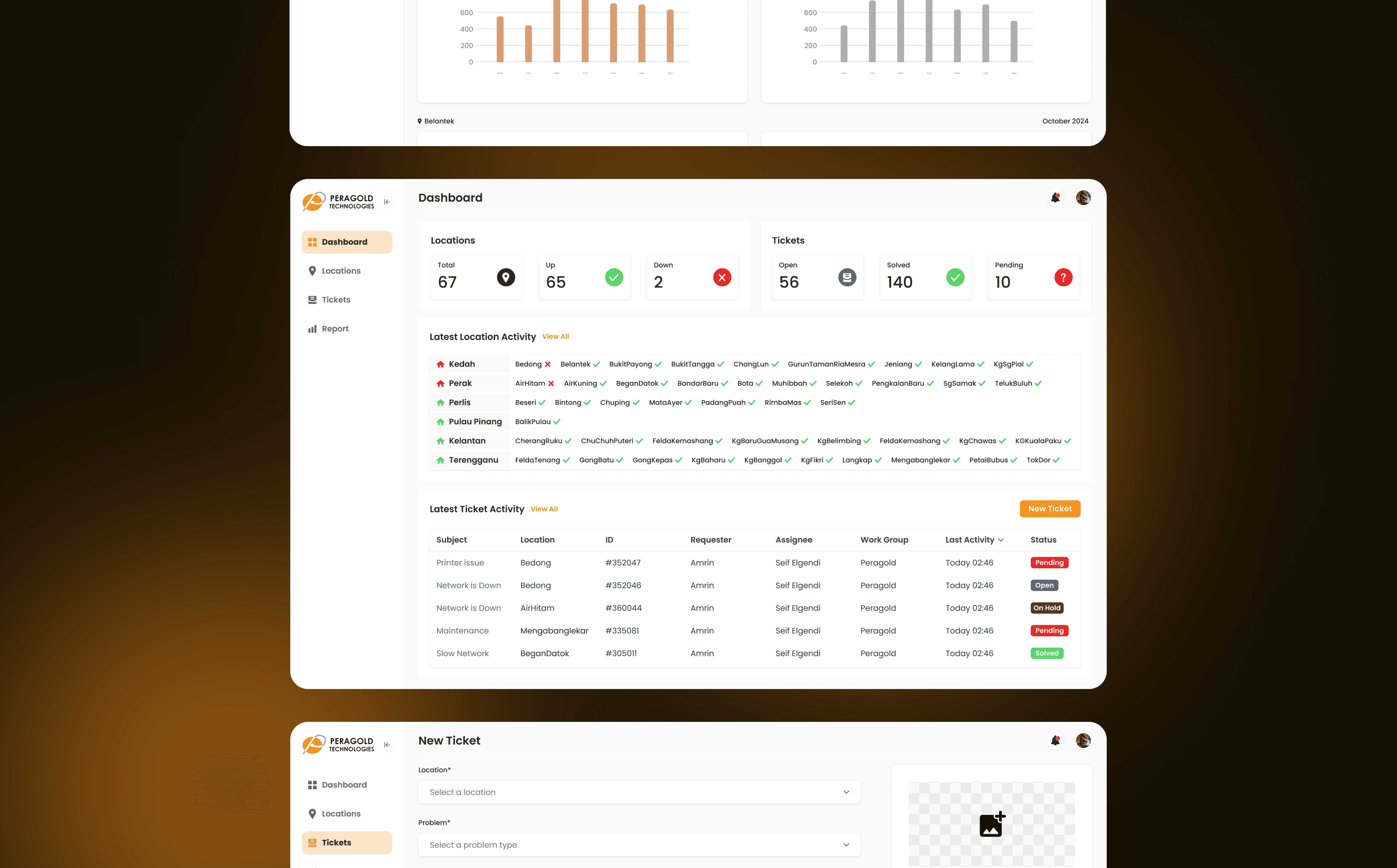
Real-time dashboard
Live network health with device status, alerts by severity, and traffic, all at a glance without switching screens.
Device mintoring
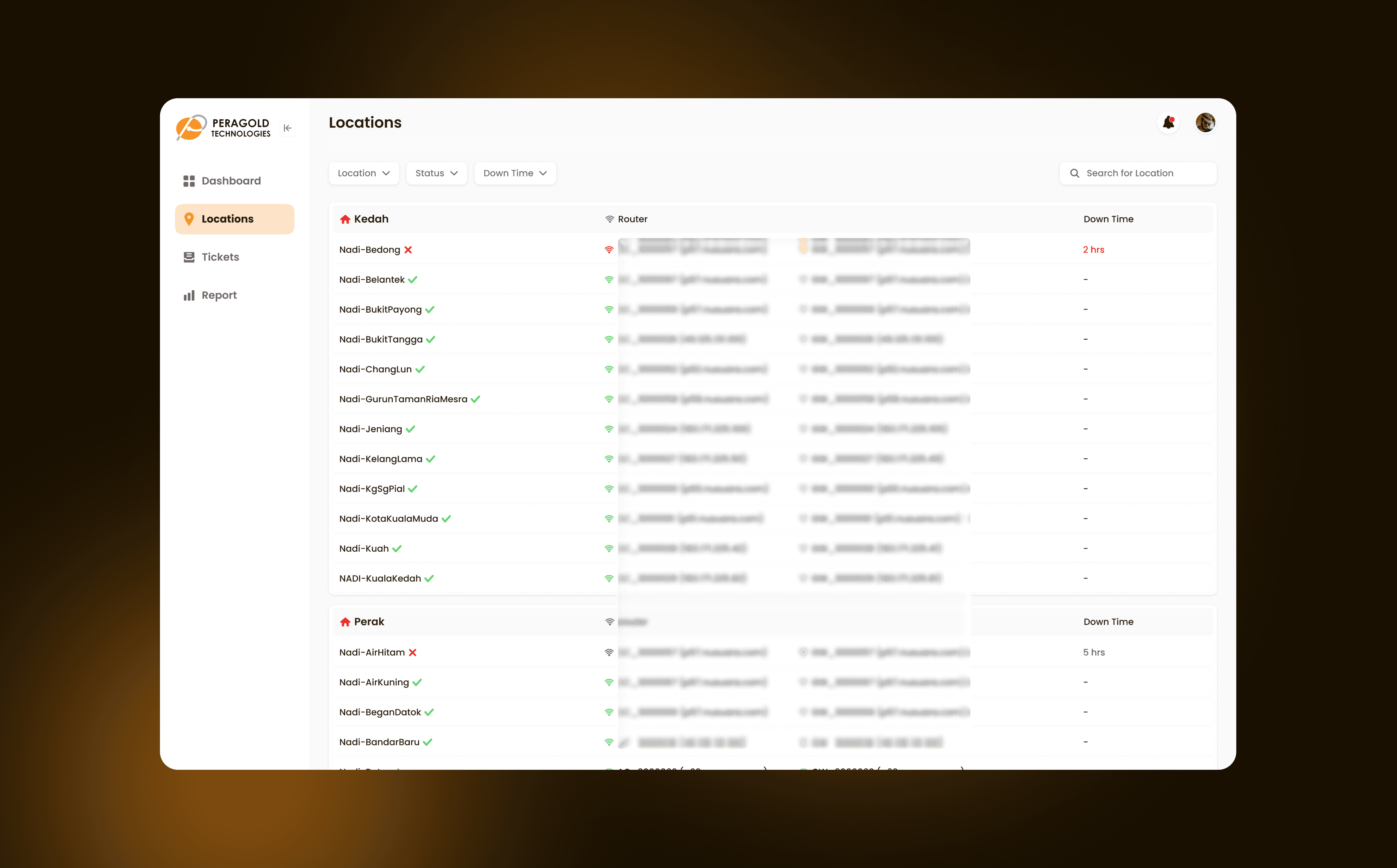
67-location network monitoring with per-device visibility into performance, downtime, alerts, and maintenance history.
Allerts center
All alerts in one place, severity-tagged so engineers know exactly where to look first without parsing noise.
IT support ticketing
End-to-end ticket flow for internal requests submission, assignment, status tracking, and in-app notifications for every update.
Performance KPIs
Uptime, bandwidth, and latency in clean, readable charts that both engineers and operations managers can interpret.
MCMC regulatory reports
Compliance-ready monthly reports with filterable KPIs and single-click PDF export. Days of manual work eliminated.
Auto ticket creation, the standout feature
When a network issue persists beyond two hours, the system automatically creates a ticket and notifies the responsible team. No manual reporting. No dependency on someone noticing. The escalation happens whether anyone is watching or not.
03 - MY ROLE
Sole Product Designer, project manager, and everything between
On this project I was not just the designer. I was also the person responsible for keeping the project moving, aligning stakeholders, running meetings, managing the development team, and making sure what shipped matched what was designed. That dual role shaped how I worked and what the product became.
Stakeholder alignment
Ran regular meetings with Peragold stakeholders to surface requirements, present design decisions, and build shared understanding of what the product needed to do and why.
Developer collaboration
Worked closely with developers throughout implementation reviewing builds, clarifying design intent, flagging deviations early, and making real-time decisions to keep delivery moving.
QA and bug reporting
Tested every module systematically before and after releases. Documented bugs with clear reproduction steps, severity tags, and expected vs actual behaviour to make fixing faster and unambiguous.
Project and timeline management
Kept the project on schedule by coordinating across design, development, and client review cycles managing dependencies, setting realistic expectations, and resolving blockers before they became delays.
I did not hand this off. I ran the meetings, managed the developers, tested every screen, and reported every bug, while designing the whole thing.
04 - FEATURE SPOTLIGHT
The feature that changed operations most
Auto ticket creation removed an entire category of human dependency from the escalation process. Before this, a WiFi access point could be offline for hours, or longer without anyone filing a report. Not because engineers were careless. Because the system gave them no trigger, no reminder, and no mechanism to know.
Device offline
NMS detects connectivity loss immediately
2-hour threshold
System monitors, no manual check required
Ticket auto-created
Assigned to the right team instantly
Team notified
In-app alert triggers resolution workflow
This feature did not improve an existing workflow. It eliminated the conditions under which that workflow was needed. Engineers no longer had to notice, remember, and manually report a prolonged outage the system handled all of it. That is the difference between polishing a process and removing the need for it.
05 - Screens
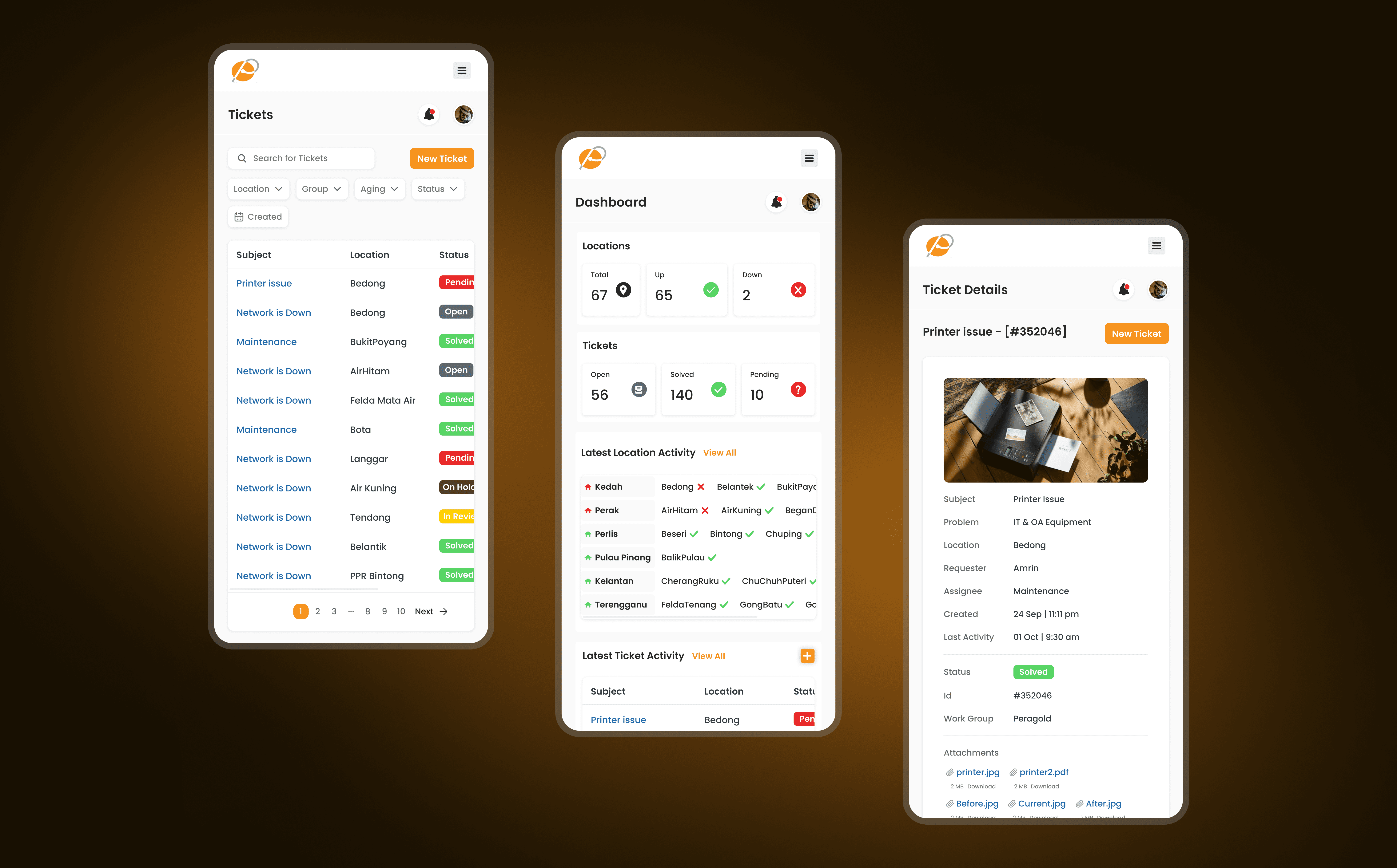
Designed for speed, readable under pressure
Every screen answers the same question: what does this user need to see and act on right now, not what the system is capable of displaying.
06 - OUTCOMES
What the product actually changed
The NMS launched as a live production system. Without controlled A/B metrics, the honest measure of success is whether the system now supports how engineers, IT officers, and compliance teams actually work. In every case, it does, and in several, it removed categories of manual effort entirely.
4
1
Systems consolidated into one platform
Engineers monitor, manage tickets, and pull compliance reports from a single surface. No more context switching across four tools per shift.
Days
Min
MCMC reporting time eliminated
What previously required two days of manual data gathering and formatting is now a single export action. The compliance team reclaimed that time every month.
0
Auto
Outage escalation no longer manual
Prolonged network outages now trigger automatic ticket creation and team notification. A failure mode that existed before simply no longer exists.
100%
IT request lifecycle now fully visible
Every support request has an owner, a status, and a notification trail. Nothing falls through the cracks because there are no cracks left in the process.
The best operational tool is the one that removes the most human effort from processes that should never have required human effort in the first place.
07 - DESIGN THINKING
Built for people under real pressure
An NMS is not a product people browse. It is a tool people reach for during incidents, at odd hours, when something is wrong and the clock is running. Every UX decision had to be measured against that reality.
Fast drill down at every level
Every alert, ticket, and device status links directly to its detail and action. Engineers move forward through the system, never back to find where they came from.
Consistent filters
Date ranges, zones, device types, and status filters behave identically across monitoring, ticketing, and reporting. Learn the pattern once, use it everywhere.
Mobile ready for engineers
Field staff submitting and tracking tickets needed a real mobile experience, not a scaled-down desktop. Responsive design was treated as a primary use case, not a fallback.
08 - KEY DECISIONS
What I chose, and what I traded away
DECISION 01
Why two hours, and why it was a design decision
The auto ticket feature needed a threshold. Too short and engineers face noise. Too long and real incidents slip. Two hours was anchored in how the operations team described their actual resolution window anything within it was being handled, anything past it was being missed. The threshold made the system's logic match reality, not an arbitrary rule.
Risk accepted
A fixed threshold cannot cover every edge case. Some incidents resolved just past the mark, some needed faster escalation. It is a calibrated default, not a perfect rule.
What we gained
Prolonged outages no longer depended on someone remembering to file a report. Escalation became automatic, consistent, and guaranteed removing a full failure mode..
DECISION 02
Designing for compliance output, not data exploration
The reporting module could have been a flexible analytics dashboard filters, custom ranges, chart builders. More impressive in a demo. But the compliance team's actual job was specific: produce the monthly MCMC submission, correctly formatted, exportable immediately. I designed for that outcome, not a general-purpose tool that required them to reconstruct the right report from scratch every month.
What I gave up
Flexibility for ad-hoc data exploration beyond the MCMC scope. Teams with non-standard reporting needs would need a separate path.
What we gained
A compliance flow that takes minutes instead of days. The module does one job extremely well for the people who need it most.
DECISION 03
Building shared foundations before building features
With seven modules across three user types, the pressure was to ship screens quickly. But inconsistent patterns across modules were one of the root causes of the trust problem engineers had with the existing tools. I paused feature design early and established shared patterns for tables, filters, status indicators, modals, forms, and notifications first. It cost time upfront. Every screen that followed started from the same foundation.
What I gave up
Early momentum. Stakeholders see patterns and components, not finished screens, a harder sell at the start of a project.
What we gained
A product that behaves consistently across all seven modules. No relearning between sections. Trust built through predictability.
09 - WHAT THIS DEMONSTRATES
The kind of work this project required
An NMS is not a product people browse. It is a tool people reach for during incidents, at odd hours, when something is wrong and the clock is running. Every UX decision had to be measured against that reality.
Live product, real delivery
Not a redesign concept. A shipped system with real teams depending on it daily across operations and compliance.
Designer and project manager
Ran stakeholder meetings, managed the dev team, conducted QA, and reported bugs while designing the product in full.
Multi-module, multi-user complexity
Seven modules across three distinct user types, designed and delivered from discovery through to production.
Automation as design thinking
Auto ticket creation removed a human failure mode entirely that is systems thinking applied at the product level.
10 - REFLECTION
What this taught me.
The strongest design decisions on this project were not the ones that made existing workflows smoother. They were the ones that removed the conditions under which certain workflows were needed at all. Auto ticket creation did not improve how engineers reported prolonged outages across 67 locations, it made the question of whether they would remember to report irrelevant. Finding that kind of leverage requires understanding how people actually fail in a system, not just what features are missing from it.
Running this project as both designer and project manager sharpened something I did not fully expect: the closer you are to implementation, the better your design decisions become. Managing developers, conducting QA, and reporting bugs meant I was in the product constantly not waiting on feedback cycles but catching gaps in real time and making decisions that kept quality intact all the way to production.
This project sits in my portfolio alongside Flowpamine because it demonstrates a different dimension of the same discipline. Flowpamine was about designing thinking systems for knowledge workers. NMS was about designing operational tools for engineers under real-time pressure with compliance obligations and 67 locations to monitor. Both required systems thinking. Both required designing for people who cannot afford for the product to be unclear. That is where I do my best work.
Looking to start a project or you need consultation? Feel free to contact me.
Kuala Lumpur, Malaysia